The Social Side of Smoking in Relaxed Settings

Smoking has long had a social dimension in many cultures. Beyond the act itself, it has often been associated with conversation, breaks from routine, outdoor gatherings, and moments when people step away from busy environments to spend time together.

That social context can help explain why smoking sometimes becomes connected with particular settings or routines. At the same time, it is important to distinguish the social ritual from the health risks associated with tobacco and nicotine use.

Smoking as a Social Ritual

Many social habits develop around repeated routines.

People gather for coffee, share meals, take walks, or sit outside together after dinner. Smoking has sometimes become part of similar rituals, particularly in social groups where several people already smoke.

The act of stepping outside can create a temporary change of pace and provide an informal setting for conversation.

The Importance of the Setting

Environment can strongly influence how social interactions feel.

A quiet patio, garden, balcony, or outdoor seating area generally creates a different atmosphere from a crowded workplace or busy street.

Relaxed settings often encourage longer conversations and fewer distractions.

This is one reason certain habits, including smoking, can become associated with slower and more informal social moments.

Taking a Break Together

Shared breaks can create opportunities for people to talk outside their usual roles.

Coworkers may discuss subjects unrelated to work, while friends may catch up during a pause in an evening gathering.

The social value often comes from the break itself rather than the activity that accompanies it.

Recognizing that distinction is useful because the same kind of connection can be created through many different routines.

Conversation Without a Formal Agenda

Some of the most natural conversations happen when nobody has planned a specific topic.

Relaxed environments allow discussions to develop gradually.

People may talk about work, relationships, hobbies, travel, entertainment, or everyday experiences.

Smoking areas have historically provided one setting where these informal conversations occur, although similar interactions can happen around coffee, food, or simply sitting outside.

Outdoor Social Spaces

Outdoor areas frequently play an important role in smoking-related social habits.

Patios, terraces, courtyards, and gardens provide places where people can gather without affecting indoor environments.

Many modern homes and hospitality spaces also separate smoking areas from nonsmoking areas.

This helps accommodate different preferences while reducing unwanted smoke exposure.

Respecting Nonsmokers

Social comfort depends on considering everyone in the group.

Not everyone wants to be around tobacco smoke, and secondhand smoke carries documented health risks.

Smokers should therefore pay attention to designated areas and avoid smoking close to people who prefer not to be exposed.

Respectful boundaries make mixed social gatherings more comfortable.

Local Rules Matter

Smoking regulations vary significantly between locations.

Restaurants, workplaces, apartment buildings, parks, and entertainment venues may have their own restrictions in addition to local laws.

People should check the rules before lighting up in an unfamiliar setting.

Assuming that an outdoor location automatically permits smoking can create unnecessary conflict.

The Role of Personal Routines

Social smoking is often connected to specific routines.

For example, someone may associate smoking with:

  • Having coffee
  • Finishing a meal
  • Meeting friends outdoors
  • Taking a work break
  • Attending certain social events

These associations can become strong because the brain links activities and environments through repetition.

Understanding these patterns can be useful for anyone trying to better understand their own habits.

Social Influence

People often adopt behaviors partly because of the people around them.

A person who rarely smokes alone may be more likely to do so when spending time with friends who smoke.

This phenomenon is not unique to tobacco. Social environments influence food choices, alcohol consumption, exercise, spending, and many other behaviors.

Being aware of group influence can help people make more deliberate personal decisions.

Smoking and Hospitality

Historically, some hospitality environments incorporated smoking into the overall social experience.

Lounges, outdoor terraces, and certain entertainment venues sometimes created designated spaces specifically for smokers.

Today, regulations and changing preferences have reduced smoking in many public places.

Where designated areas still exist, operators generally need to balance smoker convenience with the comfort and safety of other guests.

Personal Choice and Social Pressure

There is an important difference between choosing to smoke and feeling pressured to participate.

Nobody should feel that smoking is required to belong to a particular group.

Friends can socialize together even when their habits differ.

Creating an environment where people can comfortably decline helps keep social interactions inclusive.

Alternatives to the Smoking Break

People who enjoy the social element of smoking but want to reduce or stop can preserve much of the routine without tobacco.

For example, they might still step outside with colleagues, take a short walk, drink coffee, or simply join the conversation.

The social connection does not necessarily depend on smoking itself.

This can be particularly useful for people who are trying to change established habits.

How Products Become Part of Social Routines

Consumer products often become associated with specific moments, environments, or rituals, whether those products involve beverages, snacks, clothing, or lifestyle accessories. People researching different products online may encounter retailers or listings such as discountsmokes, but purchasing decisions should always be based on accurate product information and individual preferences.

The Role of Tradition

In some families and communities, smoking has historically been connected with particular gatherings.

Older generations may remember smoking being far more common at restaurants, parties, offices, and social events.

Changing health knowledge and regulations have significantly altered those norms.

As a result, younger generations may experience smoking as a much more limited or separated activity.

Cultural Differences

Attitudes toward smoking vary widely between countries and communities.

In some places, outdoor café smoking remains relatively common.

In others, smoking has become uncommon even in outdoor social spaces.

Travelers should be mindful of local customs as well as regulations.

What feels normal in one location may be considered inappropriate somewhere else.

The Importance of Ventilation and Distance

Outdoor smoking does not completely eliminate exposure for nearby people.

Wind direction, seating arrangements, and distance can all influence where smoke travels.

Providing adequate separation from entrances, windows, and crowded seating areas can reduce unwanted exposure.

These considerations are especially important around children and people with respiratory sensitivities.

Avoiding Smoking Around Children

Children should be protected from tobacco smoke.

Adults who smoke should avoid doing so around children, including in vehicles and enclosed spaces.

Even when gatherings are casual, protecting younger people from secondhand smoke should remain a priority.

Social convenience should not override health considerations.

Recognizing Habitual Triggers

Relaxed environments can become triggers precisely because they are associated with previous smoking experiences.

A particular chair, drink, friend group, or time of day can prompt a familiar routine.

People who want to reduce smoking may benefit from identifying these triggers.

Changing the surrounding routine can sometimes make behavioral changes easier.

Socializing Without Smoke

Modern social spaces increasingly accommodate people who prefer smoke-free environments.

Outdoor cafés, parks, patios, and community areas can still provide relaxed conversation without making smoking the center of the experience.

This shift reflects broader changes in public health awareness and social expectations.

The underlying desire for connection remains the same.

Courtesy in Shared Spaces

Simple courtesy can prevent many disagreements.

Smokers can ask whether others are comfortable before smoking nearby.

They can also use designated areas and properly dispose of cigarette waste.

Nonsmokers can communicate their preferences clearly.

Mutual respect usually makes mixed social groups easier to manage.

Proper Disposal

Cigarette ends should never be discarded on sidewalks, beaches, parks, or landscaping.

They create litter and can present a fire risk.

Outdoor smoking areas should have suitable disposal containers.

Responsible disposal is a basic part of using shared spaces respectfully.

Fire Safety

Smoking materials can ignite dry vegetation, furniture, or waste.

Extra caution is necessary during dry weather or in areas with elevated wildfire risk.

People should fully extinguish smoking materials and follow local fire restrictions.

A relaxed atmosphere should never lead to careless handling.

Health Considerations

Although smoking can have a social component, tobacco use carries substantial health risks.

These include increased risks of cancer, cardiovascular disease, respiratory illness, and other serious conditions.

Secondhand smoke can also affect people nearby.

Understanding the social context of smoking should not be confused with minimizing these risks.

Supporting Someone Who Wants to Quit

Social groups can influence smoking behavior in both directions.

Friends can make quitting harder if every gathering revolves around cigarettes, but they can also provide meaningful support.

Respecting someone’s decision not to smoke and avoiding pressure can make social situations easier.

The goal should be to preserve the friendship rather than the habit.

Redefining the Break

One useful perspective is to separate the desire for a break from the desire to smoke.

People often benefit from stepping away from work, getting fresh air, or talking with someone for a few minutes.

Those benefits can remain even without tobacco.

This makes it possible to preserve the social ritual while changing the behavior.

Creating More Inclusive Social Settings

The most comfortable gatherings usually give people options.

Smokers may use an appropriate designated area, while nonsmokers can remain in a smoke-free space.

Nobody should feel excluded because of their choice.

Clear boundaries and thoughtful planning can make the environment more welcoming.

Conclusion

The social side of smoking is closely connected with routine, environment, conversation, and the simple act of taking a break with other people.

Understanding those social dynamics helps explain why smoking can become attached to particular places and relationships. At the same time, tobacco-related health risks and the effects of secondhand smoke remain important considerations.

A relaxed social setting works best when personal choices are balanced with courtesy, local rules, and respect for the preferences and health of everyone nearby.

Suffering as Gift

I recently read a science fiction book called Childhood’s End by Arthur C. Clarke.

suffering
It was an interesting book in a lot of ways, but one of the concepts (almost a side-note, actually) that stuck with me was the idea that without suffering there can be no great art.
An age of peace and prosperity for all had arrived on earth, and a side effect of this was that there was no longer any great music being composed, great literature being written, great art being created.
The end of suffering meant the end of greatness.
The author, by the way, was an atheist.
An atheist was more able than many Christians to see that there is good in suffering.
This seems backwards.
We Jesus-followers in our time and place spend so much time pursuing comfort. Difficulties are viewed as a threat to one’s well-being, suffering or even mere unhappiness is seen as intolerable oppression. Do you disagree with someone at the church you attend? Leave it and find another. Do your kids annoy you? Send them off to daycare or school.

suffering
I also recently read Live Not by Lies: A Manual for Christian Dissidents by Rod Dreher. The whole book is a fascinating look at Christians who survived the totalitarian governments in the Soviet Union and warnings they want to give us in the West today.
Dreher gives an entire chapter to the idea of suffering as a gift.
He interviewed person after person who were persecuted, jailed, even tortured for being a follower of Jesus, and every single one spoke of their gratitude for the suffering they endured.
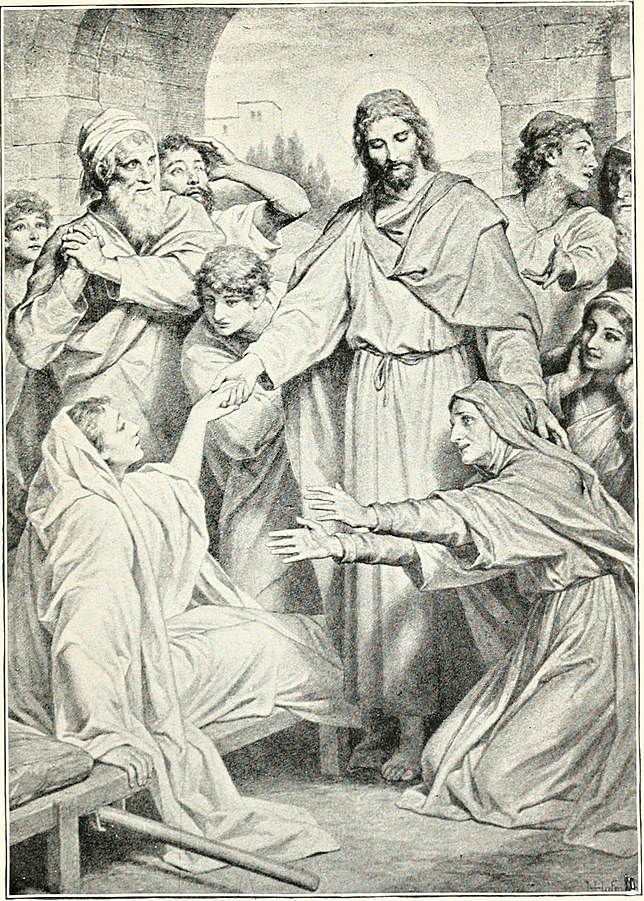
suffering as a gift
“Suffering is a part of every human’s life. We don’t know why we suffer, but your suffering is like a seal. If you put that seal on your actions, interestingly enough, people start to wonder about your truth – that maybe you are right about God. In one sense, it’s a mystery, because the Evil One wants to persuade us that there is a life without suffering. First you have to live through it, and then you try to pass on the value of suffering, because suffering has a value.”
“I’ve been thinking a lot about fear, as such. What is fear? Someone who is afraid is going to be made to do the most evil things. If someone is not afraid to say no, if your soul is free, there is nothing they can do to you. In the end, those who are afraid always end up worse than the courageous.”
“And that is why I turn back to the years of my imprisonment and say, sometimes to the astonishment of those about me: ‘Bless you, prison! … Bless you, prison, for having been in my life!'”
“Taking up your cross and carrying it is always going to be uncomfortable. We can say clearly that this current ideology of comfort is anti-Christian in its very essence. But we should point out the fact that the church, not once, ever called its followers to look for suffering, and even made it clear that they are warned not to do that. But if a person finds himself in a situation where he’s suffering, then he should bear it with courage.”
Even though doing so means to “declare oneself a kind of savage in today’s culture – even within the culture of the church,” I will say this clearly: there is great value in suffering.
To refuse to see suffering as a means of sanctification is to give way to, in Aldous Huxley’s words, “Christianity without tears.”
Again, in the words of one of the religious dissidents under the communist regime:
“Christians must embrace suffering because that’s what Jesus did, and because they have the promise, on faith, that to share in his suffering will bring glory in the next life. But sometimes, we can see results in this life.”
God does not, let me be clear, will evil to happen. He can, however, as he showed in his own Passion, permit suffering for some greater good.
No one has the power to avoid suffering – it is part of the human condition.
We cannot control whether we will encounter suffering. What we can control is how we react to it. Will we run from it and betray our Lord?
Or will we let it change us, serving as the refiner’s fire and purifying our love for God and others?

allowing a change

The End Is Not the End

Sometimes you hit the end.
the end
You have prayed and begged and pleaded with God for things to change.
You have worked and fought and wrestled to change them.
I don’t know what that is for you, but we all have or will hit an end.
An end we can’t quite understand.
Can’t quite fathom why.
Can’t quite see any good in.
It is simply the end.
the end
In the days following the crucifixion, Jesus’s followers felt the same way.
They couldn’t understand how Jesus could be dead. They couldn’t fathom why he had to die and they definitely couldn’t see any good in his death.
After Jesus was buried, the disciples left the tomb and went home.
Why not? It was the end.
They all left except one.
Only Mary Magdalene came back.
She came back on Sunday morning, saw the stone rolled away from the tomb entrance, and ran to get the other disciples.
Peter and John came running, saw the empty tomb, and …
left again.
Back to their homes.
Back to wherever you go when you hit the end.
Except, once again, Mary.
Mary stayed. wait
Again and again, she came back and waited. She couldn’t help but stay and wait.
Wait for what? She probably didn’t even know. But she stayed. And waited.
And finally, finally,
it wasn’t the end anymore.
Mary
She heard Jesus say her name.
Jesus who was definitely not dead anymore.
wait
wait
It wasn’t what anyone expected.
The disciples were certain that Jesus would defeat the Romans and establish a physical kingdom here on earth.
It was even better than what they expected.
So when you hit the end, stay. Wait.
this is not the end
Wait on God.
He is coming. He will make everything right again.
It may not be in the way you expect. It may not be in the timing you hope for.
But it will be much, much more perfect, much, much more beautiful than anything you could have imagined.
To quote the great John Lennon (because truth is truth no matter where you find it), “Everything will be okay in the end. If it’s not okay, it’s not the end.”
Wait.
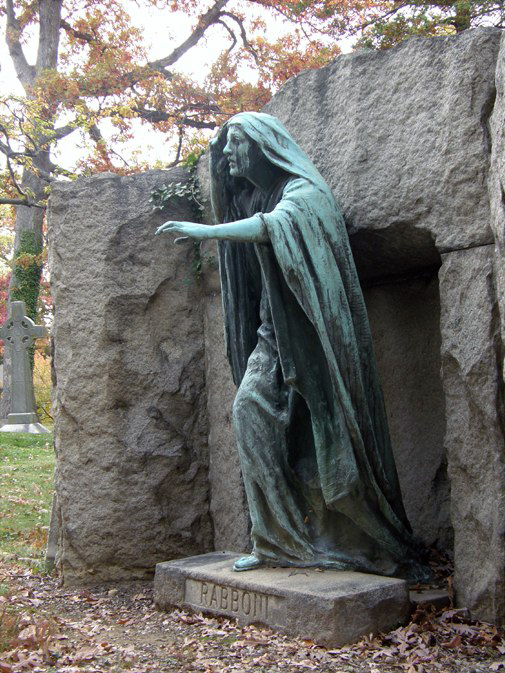
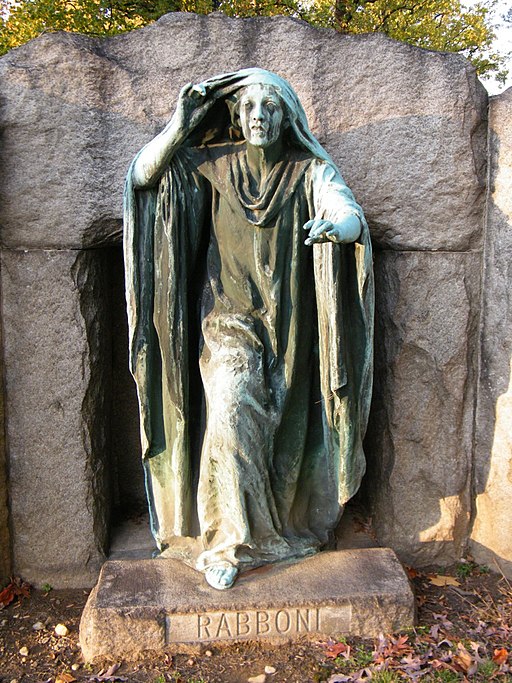
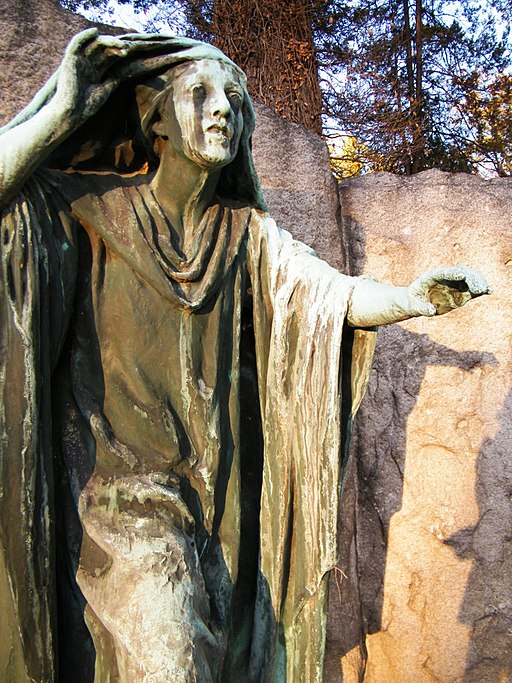
Art credit: statue is by Gutzon Borglum and can be found in Rock Creek Cemetery in Washington, D. C. (photos by Sarah Stierch)

When Your Faith Grows Less Exciting

My experience of faith, my spiritual emotions if you will, have changed over the years.
I’ve never a person who experienced extremes of emotion, but over time my experience of God was growing quieter. My life of faith was less exciting.
quieter faith
For a long time I worried that this meant I was losing my faith. I was afraid that when I met Jesus face to face, he would spit me out for being lukewarm. (Revelation 3.16)
Whether it was intended or not, the message I received from many of the churches I attended, many of the youth conferences I enjoyed, was that if I didn’t feel moved during worship, something was wrong. Wrong with me. Wrong with my worship. Wrong with my relationship with God.
Frederica Mathewes-Green writes that “where worship is relatively spontaneous, … people powered by religious emotion simply do run out of steam.” By “spontaneous,” she is referring to worship that doesn’t come from centuries of liturgy. Not that modern evangelical churches are all shallow institutions, but that liturgies have the advantage of being a steadily flowing river you can slip into and allow the prayers and Scriptures to shape you rather than attempting to rely on yourself to dredge up the necessary emotions.
less exciting faith
What I discovered after much time in prayer and reading is that rather than cooling off, my relationship with God had simply changed. It moved deeper. Silence and attentiveness are now greatly necessary to me. My faith has moved deep inside, “glowing there like a little oil lamp.”
Many of our Church Mothers and Fathers have written about why it is good to move beyond the emotions of experiencing God.
St. John of the Cross speaks of sensory benefits as the least of God’s gifts to us, a gift that he often withdraws in order to convince us to turn our eyes of faith on the Father rather than on what he is giving to us. St. John calls the desire to feel something in our time with God a “negative judgement” on God. It is a lack of trust in God doing in us what he promised to do.
In much more modern times, Richard Foster writes that “The Bible shows us that God works through long periods of our lives in which — apparently — nothing much seems to happen.”
faith apart from emotion
Mathewes-Green describes this deepening of faith, this moving away from the passions and emotions into the realm of silence and attentiveness, as something that is natural and necessary in our relationship with God, just as it does between two people who are in love. I think I will end with this quote from her:
At the beginning, the heart pounds just to see the beloved’s handwriting on an envelope; at the end, two sit side by side before a fire and don’t need to speak at all. When (churches) urge their (congregations) not to let the joy fade, they may be calling them to fight a fruitless battle against moving to the next stage of spiritual communion, the one where God moves deep inside. When years shape us to be like him, his presence is less electric and strange; yet as we draw nearer, deeper faith yields deeper awe.
May God continue to shape you to be more like him, leading you into deeper faith and deeper awe as you sit in silence with him.
deeper faith

A Tribute to Buechner

There are a handful of authors who have influenced my thoughts, my theology, my faith, and my writing more than any others.
C. S. Lewis, Madeleine L’Engle, N. T. Wright …
and Frederick Buechner. Buechner young
Buechner
Buechner wrote deep, aching truth alongside beautiful, longing hope. He saw this life of faith clearer than most, and now he sees face to face. He died a few days ago at age 96.
96 is a long life by any standards. His was a long life well lived. This kind of death brings sadness to those who will miss him and to the many more of us who will miss his words, but it is not a tragedy.
Frederick Buechner is finally face to face with the Jesus he adores. He ran this race well and now he can rest in peace with the One he loves.
In honor of the impact his writings have had on me, I pulled together some of my favorites among his words. These are in a completely random order, but I hope that they lure you into finding one of his books and letting his words sink as deeply into you as they have into me.
The final secret, I think, is this: that the words “You shall love the Lord your God” become in the end less a command than a promise. And the promise is that, yes, on the weary feet of faith and the fragile wings of hope, we will come to love him at last as from the first he has loved us – loved us even in the wilderness, especially in the wilderness, because he has been in the wilderness with us. He has been in the wilderness for us.

We draw near to him by following him even on clumsy and reluctant feet.

Adeste fidelis. That is the only answer I know for people who want to find out whether or not this is true. Come all ye faithful, and all ye who would like to be faithful if only you could, all ye who walk in darkness and hunger for light. Have faith enough, hope enough, despair enough, foolishness enough at least to draw near to see for yourselves.
I believe that…the home we long for and belong to is finally where Christ is. I believe that home is Christ’s kingdom, which exists both within us and among us as we wend our prodigal ways through the world in search of it.

We go because it is where His way leads us; and again and again we are blessed by our going in ways we can never anticipate, and our going becomes a blessing to the ones we go to because when we follow His way, we never go entirely along, and it is always something more than just ourselves and our own emptiness that we bring.

Paul says that “God chose what is foolish in the world to shame the wise. God chose what is weak in the world to shame the strong. God chose what is low and despised in the world, even things that are not, to bring to nothing things that are”, and he points to “the apparent emptiness of the world where God belongs and to how the emptiness starts to echo like an empty shell after a while until you can here in it the still, small voice of the sea, hear strength in weakness, victory in defeat, presence in absence.”

Even covered with sores and ashes, he looks oddly like a man who has asked for a crust and been given the whole loaf. (re: Job being given God himself in the middle of suffering)

Words people speak have dynamite in them and a word may be all it takes to set somebody’s heart on fire or break it in two.
So many of us are so bad at hearing each other and seeing each other that it is little wonder that one life seems enough to them or more than enough: seeing so little in this world, they think that there is little to see and that they have seen most of it already so that the rest probably is not worth seeing anyway and there is nothing new under the sun.

You often hear the advice that if you keep busy, it will be over before you know it, and the tragedy of it is that it is true.

God is the enemy whom Jacob fought there by the river, of course, and whom in one way or another we all of us fight — God, the beloved enemy … Remember Jesus of Nazareth, staggering on broken feet out of the tomb toward the Resurrection, bearing on his body the proud insignia of the defeat which is victory, the magnificent defeat of the human soul at the hands of God.

It is these very everyday moments which, if we do not look with more than our eyes or listen with more than our ears, reveal only … the gardener, a stranger coming down the road behind us, a meal like any other meal. But if we look with our hearts, if we listen with all of our being and our imagination — if we live our lives not from vacation to vacation, from escape to escape, but from the miracle of one instant of our precious lives to the miracle of the next — what we may see is Jesus himself.

Frederick Buechner also spoke of ordinary life as a fathomless mystery. He admonishes us to listen to the ordinary, everyday life and see it for what it truly is:
In the boredom and pain of it no less than in the excitement and gladness: touch, taste, smell your way to the holy and hidden heart of it because in the last analysis all moments are key moments, and life itself is grace.

The grace of God means something like: “Here is your life. You might never have been, but you are, because the party wouldn’t have been complete without you. Here is the world. Beautiful and terrible things will happen. Don’t be afraid. I am with you. Nothing can ever separate us. It’s for you I created the universe. I love you.”

Jesus Will Solve Your Problems and Make You Happy

There is something troublesome that comes across in many modern, Western churches, something that offers up Jesus as a commodity that will solve all of your troubles, heal all of your woes, and make you happy.
Trinity Lutheran
Pastors exalt the benefits of following Jesus, telling tales of miracles and answered prayers, with little to no talk of the cost of discipleship.
Much of our Western church downplays the theology of suffering and the brokenness of our world and chooses instead to emphasize the “benefits” of Christianity. While most churches wouldn’t say outright that they follow a prosperity-gospel sort of theology, many of them teach as though they deeply believe a version of it.
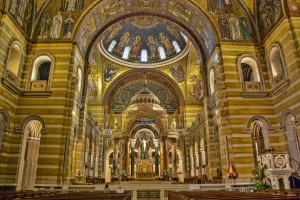
Cathedral inside
Even the songs we sing in church or on Christian radio can lean hard into the happy feelings rather than lamenting the pain that we all experience in this broken world of ours.
DSC_0092 copy
Compare, for example, the lyrics of some modern praise songs:
You’re a good, good Father
It’s who You are
or
You’ve never failed me yet
to an old hymn, Faith of Our Fathers:
Faith of our fathers, living still,
In spite of dungeon, fire, and sword;
Oh, how our hearts beat high with joy
Whene’er we hear that glorious word.
Faith of our fathers, holy faith,
We will be true to Thee till death!
Yes, I deliberately chose a few extreme examples, but when was the last time you heard anything in church, from a pastor or a song, encouraging you to remain true to God through all things, even death? When was the last time you heard about the discipline of lament, or the idea that some things in this world will never be okay until you see Jesus face to face and He is with you through it all.
Too many people have heard this “Jesus will solve your problems and make you happy” rhetoric and given a predictable “What kind of fool do you take me for?” answer.
Part of the trouble, of course, part of the reason why this notion has taken hold in so many churches is that it is true.
Not the fixing – all – your – problems part, but the way in which his presence takes root and spreads, producing peace and joy no matter what life’s circumstances. ~ Frederica Mathewes – Green in At the Corner of East and Now
There’s no great way of saying that, though. Life is full of pain. How can we say that Jesus makes everything fine without sounding schmaltzy or foolish?
It’s not something that we can really explain in words. It’s something that people must see for themselves. You have to give it a try for a while before you understand, because the pain doesn’t always go away. The cancer doesn’t always get healed, the loneliness doesn’t always vanish, the marriage doesn’t always get saved.
It doesn’t mean that you get everything you want; rather, that gradually you get to want only Jesus. ‘He will give you the desires of your heart.’ (Ps. 37.4) turns out to mean that God gives the desires themselves; our impulsive and conflicting hungers are transformed, tuned, and ordered to receive what God intends to give. ~ Mathewes-Green
In the end, we are given Jesus himself, and it turns out that Jesus is what we really wanted all along.

The Prayer that Welds the House

our house
Last week I wrote about the idea of the self being a home with two floors – the lower floor representing the physical self and the upper floor representing the spiritual self.
While many theologians over the centuries have written about this notion, mostly recently I have been reading about it in Evelyn Underhill’s Concerning the Inner Life, a book I would highly recommend.
Underhill wrote of the Lord’s Prayer as an example of one way to move in your prayers from one floor to the other and weld the whole thing together as a whole and complete house. This particular prayer “witnesses with a wonderful beauty and completeness to this two-story character of the soul’s house.” It is such a lovely and helpful way to think about this concept, so I thought I would share it with you here today.
We begin at the top of the house with the one relationship that rules all the rest:
Our Father, who art in heaven, hallowed be Thy name.
“Whatever the downstairs muddle and tension we have to deal with … all this rich and testing experience is enfolded and transfused by the cherishing, over-ruling life and power of God.”
Thy Kingdom come, Thy will be done on earth as it is in heaven.
The prayer then brings us gradually downstairs allowing the sacred to fill every space, cleansing and sanctifying it all. Thy Kingdom come – hope and expectation. Thy will be done – the loving union of our will with His.
Give us this day our daily bread, and forgive us our sins as we forgive those who sin against us. Lead us not into temptation but deliver us from evil.
Give us the “food from beyond ourselves which nourishes and sustains our life. Forgive all our little failures and excesses, neutralize the corroding power of our conflicts … we can’t deal with them alone … Lead us not into situations where we are tried beyond our strength; … and protect the weakness of the adolescent spirit against the downward pull of the inhabitants of the lower floor.”
And then? The reason for all of this.
For Thine is the kingdom and the power and the glory forever.
“… bringing together, in one supreme declaration of joy and confidence, the soul’s sense of that supporting, holy, and eternal Reality who is the Ruler and the Light … of every room in every little house.”
Thine is the kingdom and the power and the glory.
Amen and Amen

The Welding Together of the Whole House

whole house
There is so much confusion in our current place and time when it comes to our selves and what we consist of.
Some tell us that we are purely physical and have no need to consider any spiritual aspect.
Others tell us that the most important piece of us is the spiritual piece and we should disregard the physical altogether.
I confess that I tend to lean toward the latter. Most days I’d prefer to ignore my physical body completely and only tend to my spiritual life. There are probably many of you who lean the other way.
Both of these either/or views, however, don’t accurately depict the way God created humans.
God created man to be unique among all created beings. He created us to be the link between natural life and spiritual life, called to manifest his glory in both.
link between heaven and earth
Humans are
truly created a little lower than the angels, yet truly crowned with glory and worship, because in this unperfected human nature the Absolute Life itself has deigned to dwell. ~ Evelyn Underhill
We are the only beings created to be both physical and spiritual. We stand in the gap between heaven and earth, bringing God’s kingdom rule here on earth and reflecting the praises of creation back to God.
Rulers and priests.
Physical and spiritual.
It has helped me when thinking through this idea to think of the self as a house. Many theologians over the centuries have written of the self in this way.
whole house
St. Teresa of Avila, a Christian mystic in the 16th century, wrote a book called The Interior Castle in which she describes the movement between the lower floors of the castle (the physical self) and the upper floors (the spiritual self) as prayer.
Evelyn Underhill, a theologian from the early 1900’s, wrote of the self as a home with an upstairs (again, the spiritual self) and a downstairs (the physical body).
Both floors of the home are necessary. Taking care of both is essential to being a whole person in the way God intended for us to be.
Therefore a full and wholesome spiritual life can never consist of living upstairs, and forgetting to consider the ground floor and its homely uses and needs; thus ignoring the humbling fact that those upper rooms are entirely supported by it. ~ Underhill
I feel as though those words were written directly to me.
I not only tend to forget the “humbling fact that those upper rooms are entirely supported by” the ground floor, I sin against my Creator when I disparage my physical body as unimportant or less than.
Back to the singularness of human beings, the strength of our “house” consists in that “intimate welding together of the divine and the human.” (Underhill)
That intimate welding together found its perfection in the humanity and deity of Christ.
That intimate welding together is what you and I must aim toward if we are to become like Jesus, become the kind of human we were created to be.
whole house
We were created to be a whole house, with the lower and upper floors intimately welded together for the glory of God.

Art credits: painting is by Thomas Kinkade; photo of light through trees is by Kirk Sewell

Living a Mixed Life

Our lives are “extroverted to excess. Our attention is incessantly called outwards toward the multitude of details and demands …” Evelyn Underhill, 1926
Times Square
Culture has been heading this direction for a long time. Perhaps this world has always been so, developing in us a call to focus outward, a pride in busyness, a tendency to give undue importance to external details.
Many of our churches follow in the same direction, calling their people towards service and events far more than prayer, contemplation, and spiritual formation. We are asked to always be ready to give and serve yet are not told how to be filled up with anything to give.
It becomes clear, when we look at the life of Jesus, that we should live a mixed life, not a single-focused life. We should live a life of prayer and service, a life of looking and working, a life of being filled up with God and spilling that life out for others.
829px-Antoine_Édouard_Joseph_Moulinet_-_Children_at_Prayer_-_Walters_371389
To deepen our own spiritual lives to meet the demands of others, we must first spend time gazing at God. We need a vision, a conception, as clear and deep and lovely as we are able, of the splendor and beauty of God.
That enrichment of the sense of God is surely the crying need of our current Christianity. A shallow religiousness, the tendency to be content with a bright ethical piety wrongly called practical Christianity … seems to me to be one of the ruling defects of institutional religion at the present time.
We have not changed directions since Evelyn Underhill wrote this in 1926. We have only moved further down that path.
Stressing service rather than awe simply does not wear well. In those moments when the pain and mystery of life are deeply felt, in the moments when we fall into a dangerous spiritual exhaustion in the name of meetings the needs of others, this “shallow religiousness” falls flat.
St. Ignatius of Loyola said that “Man was created for this end – to praise, reverence, and serve the Lord his God.” Notice that two of the three things for which our souls were made are our relationship with God: adoration and awe. Unless these two pieces are in their correct place, the last of the triad, service, will not be right.
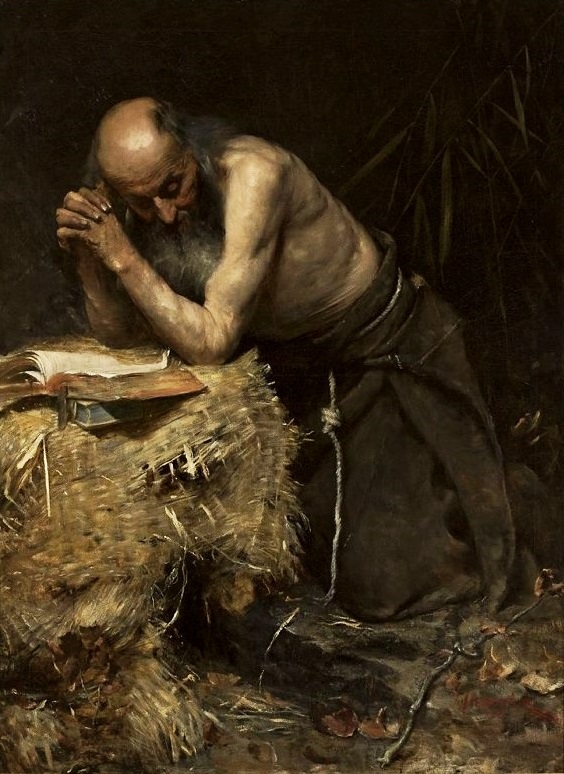
Axentowicz_The_Anchorite
Again, it is in looking to Jesus and the pattern of his own life that we see the way in which we should walk. This mixed life of prayer and service
unites the will, the imagination, and the heart; concentrates them on one single aim. In the recollected hours of prayer and meditation you do the looking; in the active and expansive hours you do the working. (Underhill)
Our secret life of prayer, the steady orientation of our hearts to the reality of God, is what leads to the desire and ability to be Jesus’s hands and feet to those around us. Ruysbroeck, a contemplative in the Middle Ages, said that the result of a perfected life of prayer was “a widespreading love to all in common.”
It is, for certain, a grace from God to have a sense of wonder and delight in him. Like all graces, however, our ability to receive it depends mostly on the exercise of our will and desire, on our openness and giving of our time to receive it. It will not be forced upon us.
Our churches are not wrong in teaching that a life of service is good and necessary, yet service should not, cannot, come first. We must first “deepen (our) own lives, that (we) are capable of deepening the lives of others.” (Underhill)
Prayer2
Christ set us an example in all things, and so it is a mixed life that we are called to live, a life of prayer and service, of looking and working. We must first take the time to be filled up with a deep and clear vision of the splendor of God; only then will we have the ability to spill out our lives in love for others.

This Frivolous Beauty

We in the West live in a world still immersed in the Enlightenment. We still believe that Truth is only what can be observed, tested, measured.
Wendell Berry calls this, the idea that the touchable world of science and matter is all there really is, our modern superstition. ” … we moderns dismiss this (idea that the world tells us about God’s love) as fancy and view the world with disenchanted eyes as a collection of atoms and dust – something to measure but not something that means.”
beauty
beauty
This, of course, has left us dissatisfied. When the only thing that exists is that which is measurable, when we are told that nothing around us has any deeper meaning, we are left discontent and searching for meaning and contentment in all the wrong places.
And when the unthinkable happens, when our world crumbles and leaves us drowning in grief and pain, we have been trained by our culture and even our churches to look to facts and information to make life easier. If we can only gather enough theological information, we believe, we can solve the problem of grief and pain.
Facts are a cold comfort, though, when we are stumbling through the darkness of suffering. It is good and necessary for us to know facts about the character of God, but we will never know the presence of the Father in data.
beauty
beauty
Our culture and even many of our churches have trained us to dismiss art, music, joy in nature, as frivolous and trivial.
The truth? These beauties are small glories offered to us as communion with our Creator.
All that exists is God’s gift to man, and it all exists to make God known to man, to make man’s life communion with God. It is divine love made food, made life for man. God blesses everything He creates, and, in biblical language, this means that He makes all creation the sign and means of His presence and wisdom, love and revelation: “O taste and see that the Lord is good.” ~ Alexander Schmemann
Art, music, the beauty of nature, all of these are God’s gift to us, one way that he enters our world of suffering and transforms it into a space where we can know his unfailing love.
beauty
beauty
Suffering cannot be transformed by theological data. There is not much that will be made new in this life. Yet while we wait for the sure renewal of all things, it is through the “triviality” of beauty, through art and music and joy in nature, that we are able to catch a glimpse of the deeper truth that is Emmanuel, God with us.
All that exists is God’s gift to man, and it all exists to make God known to man, to make man’s life communion with God.

many of the ideas in this post are from This Beautiful Truth by Sarah Clarkson

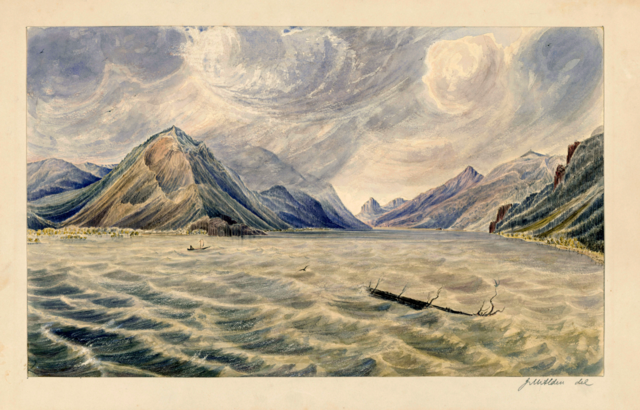
Art credits: Wind Mountain by James Madison Alden; The Water-Lily Pond by Claude Monet; photograph of mountain stream by Kirk Sewell; all other photographs are my own